

Forex Training: Complete Beginner to Advanced Guide
Forex Training: A Complete Beginner-to-Advanced Learning Guide
Forex Training is a structured learning process that helps beginners and experienced traders understand currency markets, technical analysis, fundamental analysis, and professional risk management.
A complete Forex Training program goes beyond basic chart patterns and trading signals. It teaches students how markets operate, why currency prices change, how economic indicators influence trading conditions, and how to evaluate decisions using evidence rather than assumptions.
A structured forex training program teaches you how currency markets function, why exchange rates change, how economic events affect prices, and how to evaluate trading decisions with clearly defined risks.
Whether you are a complete beginner or an experienced trader seeking to improve your analytical skills, this guide explains what professional forex training should include, how to build a realistic learning roadmap, and how to select an educational program that matches your goals.
At TUBEFX Academy, our educational approach emphasizes technical analysis, fundamental analysis, practical market interpretation, and responsible risk management, with learning options available in Urdu.
What Is Forex Training?
Forex training is a structured educational process through which students learn to understand currency markets and develop trading-related analytical skills.
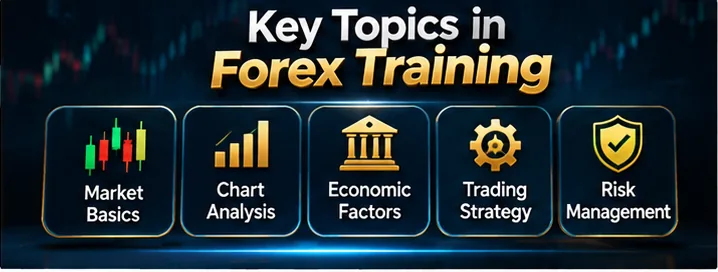
A comprehensive program typically addresses five essential questions:
- How does the forex market work? Understand currency pairs, participants, trading sessions, liquidity, and price quotations.
- Why do currency prices move? Explore economic indicators, central banks, interest rates, market expectations, and global capital flows.
- What does the price chart reveal? Learn market structure, trends, momentum, volatility, and technical confirmation.
- How can risk be controlled? Study position sizing, leverage, stop-loss planning, and the limitations of trading strategies.
- How can decisions be evaluated? Build a trading plan, practice on historical charts, document results, and review performance.
The purpose of forex training is not to predict every market movement. It is to improve the quality, consistency, and transparency of the decision-making process.
Why Is Professional Forex Training Important?
The forex market connects economies, financial institutions, businesses, governments, and investors. Currency prices respond to many interacting forces, including monetary policy expectations, economic developments, global risk sentiment, and market positioning.
Without structured training, beginners may rely excessively on isolated indicators, social media predictions, or unverified trading systems.
Professional Forex Training helps students understand how financial markets operate. However, theoretical knowledge alone is not enough to develop practical analytical skills.

For example, a trader may identify a bullish candlestick pattern, but broader market conditions may not support the setup. Therefore, technical signals should be evaluated alongside market structure, economic developments, and risk exposure.
Furthermore, proper training encourages students to document their decisions and evaluate outcomes. As a result, they can identify recurring mistakes and improve their analytical process over time.
Nevertheless, even a well-developed strategy cannot eliminate uncertainty or guarantee profitable results.
Professional education helps traders recognize that:
- A technically attractive setup can fail when market conditions change.
- Strong economic data does not always produce a stronger currency because expectations may already be priced in.
- A trend can remain established even during temporary countertrend movements.
- Higher leverage increases potential losses as well as potential gains.
- No indicator or strategy provides consistently accurate predictions.
A well-designed training framework encourages independent analysis rather than dependence on signals or guaranteed-profit claims.
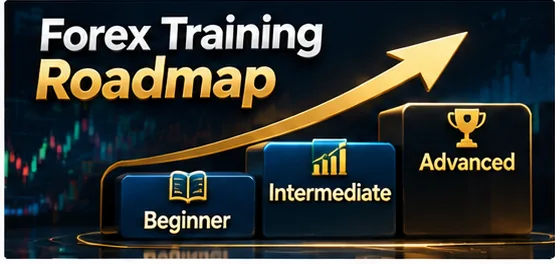
The Complete Forex Training Roadmap
A practical learning path can be divided into ten interconnected stages, progressing from market foundations to advanced analysis and performance evaluation.
Stage 1: Understand the Forex Market
Begin with the mechanics of currency trading.
The foreign exchange market is one of the world’s largest financial markets. According to the Bank for International Settlements (BIS) 2025 Triennial Central Bank Survey, average daily global OTC foreign exchange turnover reached approximately $9.6 trillion in April 2025.
Understanding the scale, participants, and structure of this market is an essential part of professional Forex Training.
Core topics
- What the foreign exchange market is
- Major, minor, and exotic currency pairs
- Base and quote currencies
- Bid, ask, and spread
- Pips, pipettes, and lot sizes
- Market orders and pending orders
- Liquidity and trading sessions
- Spot transactions, CFDs, and currency futures
- Margin, leverage, and trading costs
Practical example
Suppose EUR/USD is quoted at 1.1000.
This means that one euro is valued at approximately 1.1000 US dollars in that quotation.
If the quote moves to 1.1050, EUR/USD has increased by 50 pips, assuming the standard four-decimal pip convention.
However, the financial outcome of a trade depends on position size, transaction costs, and whether the position was long or short.
Learning objective: Read a currency quotation correctly and understand the basic mechanics of a trade before risking real money.
Stage 2: Learn Candlestick Charts and Market Structure
Price charts summarize market activity over time.
Professional chart training should explain the difference between observing price movement and assuming that a pattern guarantees a future outcome.
Core topics
- Open, high, low, and close
- Bullish and bearish candlesticks
- Higher highs and higher lows
- Lower highs and lower lows
- Trending and ranging markets
- Swing highs and swing lows
- Support and resistance zones
- Breakouts, retests, and failed breakouts
- Multiple-timeframe analysis
Practical example
Imagine that EUR/USD forms higher highs and higher lows on the daily chart.
This suggests an upward market structure during the observed period.
If the four-hour chart temporarily forms lower lows, that movement might represent a correction within the broader daily trend rather than a confirmed daily trend reversal.
The interpretation depends on the relationship between timeframes and the price levels that define each structure.
Learning objective: Identify what price has actually demonstrated before forming a directional opinion.
Stage 3: Study Technical Analysis
Technical analysis examines price history and, where relevant, volume or market activity to assess trends, momentum, volatility, and potential decision points.
Important concepts
- Moving averages
- Relative Strength Index (RSI)
- Moving Average Convergence Divergence (MACD)
- Average Directional Index (ADX)
- Trendlines and channels
- Chart patterns
- Momentum and divergence
- Average True Range (ATR)
- Price action confirmation
Professional interpretation
An RSI reading above 70 does not automatically mean that a market must fall.
Similarly, an ADX reading above a particular threshold can suggest a stronger trend, but ADX alone does not identify whether that trend is upward or downward.
Indicators should be interpreted alongside price structure, market context, and their known limitations.
Learning objective: Combine technical evidence without treating any single indicator as a guaranteed signal.
Stage 4: Master Fundamental Analysis
Fundamental analysis examines economic conditions and policy developments that may influence currency values.
Currency markets are particularly sensitive to changes in expectations about economic growth, inflation, central-bank policy, and future interest rates.
Core economic indicators
- Consumer Price Index (CPI)
- Personal Consumption Expenditures (PCE)
- Producer Price Index (PPI)
- Non-Farm Payrolls (NFP)
- Unemployment rate
- Wage growth
- Gross Domestic Product (GDP)
- Purchasing Managers’ Index (PMI)
- Retail sales
- Consumer confidence
Central banks to understand
- Federal Reserve (Fed)
- European Central Bank (ECB)
- Bank of England (BoE)
- Bank of Japan (BoJ)
- Swiss National Bank (SNB)
- Bank of Canada (BoC)
- Reserve Bank of Australia (RBA)
- Reserve Bank of New Zealand (RBNZ)
Practical example: Inflation and the US Dollar
Suppose US CPI inflation is reported at 3.2%, compared with a market forecast of 3.0%.
The positive inflation surprise could influence expectations for Federal Reserve interest-rate policy.
However, the US dollar’s reaction would also depend on the report’s details, current policy expectations, Treasury yields, broader market positioning, and other simultaneous developments.
A higher-than-expected CPI reading does not guarantee dollar appreciation.
Learning objective: Interpret economic releases in relation to expectations, policy implications, and the broader market narrative.
Stage 5: Understand Market Expectations and News Reactions
One of the most important lessons in forex training is that markets react to new information relative to what participants already expected.
A data release can appear strong in absolute terms but still disappoint investors when the expected result was even stronger.
Key learning areas
- Actual versus forecast data
- Previous readings and revisions
- Consensus expectations
- Economic surprises
- Pre-event positioning
- Central-bank communication
- Short-term volatility
- Market repricing
Example
Suppose an economic indicator rises from 52.0 to 53.0, but analysts expected 54.0.
Although the indicator improved compared with the previous period, the result was weaker than forecast.
The market reaction may therefore differ from what a simple comparison with the previous reading would suggest.
Learning objective: Analyze what changed relative to expectations, not just whether a number increased or decreased.
Stage 6: Explore Advanced Price Action and Volume Analysis
Advanced forex training may introduce concepts that help students evaluate liquidity, price behavior, and the relationship between market activity and directional movement.
Topics may include
- Break of Structure (BOS)
- Change of Character (CHoCH)
- Supply and demand zones
- Liquidity sweeps
- Fair Value Gaps (FVG)
- Order Blocks
- Volume Spread Analysis (VSA)
- Volume Price Analysis (VPA)
- Trade confirmation and invalidation
These concepts require careful interpretation.
For example, a liquidity sweep may describe price briefly moving beyond a previously observed swing level before reversing. Such a movement does not independently establish the intentions of institutional participants.
Likewise, spot forex volume displayed by many trading platforms is often tick volume rather than consolidated transaction volume for the entire global forex market.
Learning objective: Distinguish observable chart evidence from assumptions about hidden market participants.
Stage 7: Learn Intermarket Analysis and Currency Strength
Currencies are part of a wider financial system.
Professional education should explain how different markets may influence one another without presenting correlations as permanent laws.
Important relationships to study
- US Dollar Index (DXY)
- Government bond yields
- Interest-rate differentials
- Gold and the US dollar
- Oil prices and commodity-linked currencies
- Equity-market risk sentiment
- Currency strength and weakness
- Commitment of Traders (COT) reports
Practical example
A trader analyzing USD/JPY might examine Federal Reserve policy, Bank of Japan policy, changes in US and Japanese yields, and broader risk sentiment.
These factors can help build a fundamental framework, but the relationship between any single variable and USD/JPY may change over time.
Learning objective: Develop a multi-factor market view instead of relying on a single correlation.
Stage 8: Develop Risk Management Skills
Risk management is an essential part of Forex Training because leveraged trading can expose participants to substantial financial losses.
The U.S. Securities and Exchange Commission’s Investor.gov Forex Trading Risk Guide explains how leverage can magnify market movements and why investors should carefully evaluate the risks before participating in foreign currency trading.
Risk management is one of the most important components of any forex education program.

Even a carefully researched trade can result in a loss.
Essential topics
- Risk per trade
- Position sizing
- Stop-loss placement
- Risk-to-reward ratios
- Leverage exposure
- Drawdowns
- Correlated positions
- Slippage and trading costs
- Trading journals
- Capital preservation
Hypothetical position-sizing example
Assume:
- Account balance: $5,000
- Illustrative risk allowance: 1%
- Maximum planned loss: $50
- Stop-loss distance: 50 pips
- Assumed pip value for one standard EUR/USD lot: $10 per pip
The calculated position size would be:
Position size = $50 ÷ (50 pips × $10)
Result: 0.10 standard lot
This simplified example excludes slippage, spreads, commissions, currency conversion, and instrument-specific contract differences. It is not a recommended position size for every trader.
Learning objective: Calculate financial exposure before entering a position and recognize that stop-loss orders cannot guarantee an exact maximum loss under all market conditions.
Stage 9: Combine Technical and Fundamental Analysis
Technical and fundamental analysis answer different but complementary questions.
Fundamental analysis examines economic and policy conditions that may influence currency demand.
Technical analysis evaluates observable price structure, momentum, volatility, and potential decision levels.
A combined analysis framework can include:
| Analysis Component | Key Question |
|---|---|
| Economic Outlook | Which economy faces stronger or weaker conditions? |
| Central-Bank Policy | How might interest-rate expectations change? |
| Market Expectations | What developments are already priced in? |
| Daily Chart | What is the broader price structure? |
| Four-Hour Chart | Is the shorter-term movement confirming or challenging that structure? |
| Risk Management | What would invalidate the analysis? |
Hypothetical example
Suppose the fundamental outlook favors the euro relative to the dollar.
Rather than immediately buying EUR/USD, a trader might examine the daily trend, four-hour structure, important resistance levels, market volatility, and upcoming economic events.
If price action contradicts the fundamental scenario, the trader should reassess the evidence rather than forcing a position.
Learning objective: Develop a structured market thesis that includes both supporting evidence and conditions that would invalidate it.
Stage 10: Practice, Backtest, and Review Performance
Learning concepts is only the first stage. Students also need a method for evaluating whether they understand and can apply those concepts.
A practical development process includes:
- Reviewing historical price charts
- Recording hypothetical trade ideas
- Practicing on a demo account
- Identifying entry and invalidation conditions
- Calculating potential position risk
- Maintaining a trading journal
- Reviewing repeated decision-making errors
- Measuring results over a meaningful sample
- Separating strategy performance from emotional decisions
Backtesting can reveal weaknesses in a trading approach, but historical results do not guarantee future outcomes. Demo performance may also differ from live trading because of execution conditions, costs, and psychological factors.
Learning objective: Build a repeatable learning process and evaluate decisions using documented evidence.
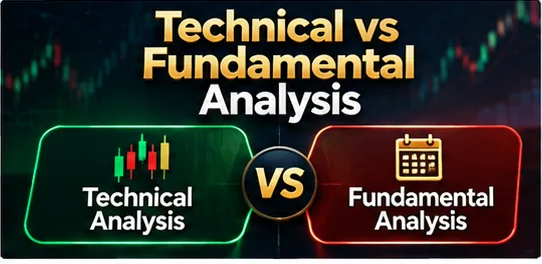
Technical Analysis vs Fundamental Analysis: Which Should You Learn First?
Beginners do not need to choose one permanently.
A practical sequence is to learn basic chart reading first, then introduce the economic factors that influence currency prices.
| Technical Analysis | Fundamental Analysis |
|---|---|
| Studies historical price behavior | Studies economic and policy conditions |
| Examines trends and momentum | Examines inflation, growth, and employment |
| Identifies chart-based decision levels | Evaluates currency-related economic expectations |
| Helps assess entry and invalidation zones | Helps understand broader market drivers |
| Has limitations and false signals | Has uncertainty and changing market reactions |
For advanced students, learning how these methods interact can be more useful than treating them as competing approaches.
Online Forex Training vs Live One-to-One Classes
Different students benefit from different learning formats.
Recorded Online Forex Courses
Self-paced lessons can be useful for students who prefer flexible schedules and the ability to revisit difficult subjects.
Potential advantages include:
- Learning at your own pace
- Reviewing lessons multiple times
- Following a structured curriculum
- Building foundational knowledge before live practice
Live One-to-One Forex Training
Personalized classes may be suitable for students who prefer guided instruction and direct feedback.
Potential advantages include:
- Questions and answers during lessons
- Practical chart discussions
- Personalized explanations
- Guided exercises and progress reviews
- Support in identifying gaps in understanding
Neither format guarantees trading profitability. The right choice depends on learning style, course quality, available time, and personal objectives.
Forex Training for Beginners: A Practical 12-Week Study Framework
The following is an illustrative self-study roadmap, not a promise about the duration of any particular TUBEFX course.
| Weeks | Learning Focus |
|---|---|
| 1–2 | Forex basics, currency pairs, pips, leverage and trading costs |
| 3–4 | Candlesticks, market structure and support/resistance |
| 5–6 | Indicators, price action and multiple timeframes |
| 7–8 | Economic indicators and central-bank policies |
| 9–10 | Risk management and combined market analysis |
| 11–12 | Demo practice, backtesting and performance review |
Students may need additional time depending on their experience and the depth of each topic.
Common Mistakes to Avoid During Forex Training
1. Looking for Guaranteed Trading Signals
No trading method can eliminate uncertainty. Education should explain risks rather than promise consistent profits.
2. Learning Indicators Without Market Context
An indicator may produce different results in trending, ranging, or highly volatile markets.
3. Ignoring Economic Events
Major policy announcements and economic releases can significantly affect volatility and execution conditions.
4. Using Excessive Leverage
High leverage can magnify losses and may cause substantial capital depletion.
5. Confusing Historical Charts With Predictions
A pattern that appeared in past price data does not guarantee the same outcome in the future.
6. Trading Without a Written Plan
A structured plan should define the rationale, risk exposure, confirmation, invalidation, and review process.
7. Measuring Success Only Through Profits
A short sequence of profitable trades does not necessarily demonstrate a robust trading strategy.
How to Choose a Forex Training Course
Before enrolling, evaluate the following:
Curriculum Quality: Does the program cover market fundamentals, technical analysis, fundamental analysis, and risk management?
Instructor Transparency: Is the instructor’s educational background and relevant experience explained without exaggerated claims?
Practical Learning: Are students shown how to interpret evidence rather than simply copy trading signals?
Risk Disclosure: Does the course explain leverage, losses, trading costs, and the limitations of strategies?
Learning Format: Are lessons recorded, live, personalized, or a combination?
Course Details: Are fees, delivery methods, schedules, and access conditions clearly explained?
Realistic Outcomes: Does the provider avoid guarantees of income, profits, or financial independence?
Good forex training should help students become better informed and more independent, not dependent on a particular instructor’s predictions.
Learn Forex Training in Urdu With TUBEFX Academy
TUBEFX Academy provides educational resources for students who prefer to learn financial-market concepts in Urdu while becoming familiar with professional English trading terminology.
Our educational topics include:
- Forex market foundations
- Technical analysis and price action
- Fundamental and economic analysis
- Central-bank policy interpretation
- Currency strength and intermarket relationships
- Volume and market-structure concepts
- Risk management and practical chart interpretation
Available learning options include recorded Urdu lessons and live one-to-one Zoom training.
Explore our learning resources: https://www.urduforextraining.com/
Read our introductory Forex Trading guide: https://www.urduforextraining.com/what-is-forex-trading/
Learn more about TUBEFX Academy: https://www.urduforextraining.com/about-us/
Our educational philosophy is straightforward:
Read the Chart. Verify the Evidence. Manage the Risk.
Frequently Asked Questions About Forex Training
What is forex training?
Forex training is the structured study of currency markets, chart analysis, economic fundamentals, trading mechanics, risk management, and practical decision-making.
Can beginners learn forex trading?
Yes. Beginners can learn the underlying concepts through structured study and practice. However, acquiring knowledge does not ensure successful or profitable trading.
Is forex training available online?
Yes. Online forex training may include recorded lessons, live virtual instruction, practical assignments, and self-directed learning materials.
Should I learn technical or fundamental analysis first?
Beginners can start with basic market mechanics and chart reading, then progressively study economic indicators and monetary policy. Both approaches have value and limitations.
How long does it take to learn forex trading?
The time required varies significantly. Basic concepts can be introduced in weeks, while developing analytical judgment and consistent risk-management habits may take considerably longer.
Do I need a large account to practice forex analysis?
No. Much of the learning process can be completed through historical chart review, educational exercises, and demo accounts without risking real funds.
Is forex training the same as forex signals?
No. Training focuses on developing understanding and independent analytical skills. Signals generally provide specific trading suggestions without necessarily teaching the reasoning behind them.
Can forex training guarantee profits?
No. Financial markets are uncertain, and even experienced traders can suffer substantial losses. No educational course can guarantee profitable outcomes.
What is the best forex training approach?
A structured combination of market foundations, technical and fundamental analysis, risk management, practical exercises, and performance review offers a comprehensive educational framework.
Can I learn forex trading in Urdu?
Yes. TUBEFX Academy offers Urdu-focused educational resources, recorded lessons, and live training options that use professional English financial terminology alongside Urdu explanations.
Final Thoughts: Build Skills Before Taking Risks
Forex training should be approached as a long-term educational process rather than a shortcut to quick financial gains.
Understanding currency pairs is only the beginning. A serious student must also learn to analyze price behavior, interpret economic information, recognize uncertainty, calculate risk, and evaluate decisions objectively.
The most valuable outcome of professional forex training is not the ability to predict every market movement. It is the development of a disciplined framework for understanding financial markets and managing uncertainty.
Explore TUBEFX Academy’s forex education resources and choose a learning approach that matches your experience and goals.
Educational Risk Disclaimer
This article is provided for general education only and does not constitute personal investment advice, a recommendation to trade, or an offer of financial services. Forex, CFDs, and leveraged products involve significant financial risk and may not be suitable for every individual. Losses can be substantial. Past performance, hypothetical scenarios, and educational examples do not guarantee future results. Always consider your financial circumstances, applicable regulations, and the risks of any trading activity.

You may also like